

Define the complete operating sequence
A bagger and a palletizer leave several decisions open. Begin with the upstream material supply, feeding and weighing. Specify the bag type and how empty bags are presented and placed. Follow filling with the required closing method: sewing, sealing or another closure appropriate to the actual bag and liner.
Continue through conveying, bag orientation, palletizing, empty-pallet supply and full-pallet removal. Mark the controls and interlocks between these steps. Ask the supplier to label each task as automatic, operator-assisted, existing equipment or excluded from the supply.
For FIBC filling, define bulk-bag support, connection, closure and full-bag removal separately. A palletizer for individual bags does not establish filled-FIBC handling. The bulk-bag filling guide covers that handling boundary.
Agree who supplies and connects each interface
List existing machines and their connection points before asking for a layout. For each handoff, confirm the material or bag condition, transfer height, receiving position and responsible supplier. These details make quotations comparable and expose gaps between equipment packages.
| Interface | Buyer input | Confirm in the proposal |
|---|---|---|
| Material supply → weighing | Upstream outlet, supply interruptions and material behaviour | Who supplies the connection and how feeding responds to an empty or interrupted source |
| Filling → closing | Bag opening, liner, closure method and operator tasks | How the filled bag is supported, presented and closed |
| Closing → palletizer infeed | Finished bag shape, transfer heights and incoming orientation | Conveyor transfer, spacing, orientation and any bag conditioning included |
| Palletizing → finished-load exit | Pallet specification, stack plan and removal route | Empty-pallet supply, pallet change, full-pallet transfer and their effect on the cycle |
| Controls → connected equipment | Existing controls and the intended operating sequence | Responsibility for signals, interlocks, stop/restart behaviour and interface testing |
Wisdom's complete-line solution describes integration around the agreed equipment and site interfaces. Wisdom can integrate confirmed equipment and systems; confirm the supplied and bought-out scope in the quotation. Its palletizing page explicitly identifies purchased industrial robots used in robotic workstations. Ask who supplies and supports the robot body, electrical components, pneumatics and any other bought-out equipment.
Balance the line around its constrained step
Sustained line output is limited by the slowest or otherwise constrained operation under the agreed conditions. A bagger's stated filling speed does not establish how quickly closed bags become finished pallets. RBTX Learn's bottleneck guidance discusses this principle across packaging lines, including transfers and coordinated operation.
Review bag placement, filling, closing, conveying, orientation, palletizing and pallet change as one cycle. Some tasks can overlap; others stop the flow. Ask what happens when a downstream station is occupied or the upstream source pauses, and whether the proposed buffer or operating sequence can accommodate that event.
Compare output proposals using the same material, filled bag, closure, pallet pattern and operating assumptions. Agree an observation period and how changeovers or interruptions are counted. Require evidence for the whole sequence rather than adding individual machine speeds together.
Carry the filled-bag condition downstream
A bag that leaves the filler must reach closing and palletizing in a usable condition. Review the supported transfer through closing, the bag's shape afterward, and its arrival orientation and spacing at the palletizer. Identify any turning or conditioning step in the actual scope.
The bagging configuration sets the upstream bag-handling sequence. Use the feeding-system guide to examine material supply and dosing. The downstream palletizing proposal must then match the filled bag rather than its empty dimensions.
Ask which signals permit a bag to advance and which conditions stop or restart adjacent equipment. BEUMER's technical discussion of connected packaging operations illustrates why an interruption at packaging can affect the upstream process. Its software and equipment features are BEUMER's own; the control functions for your line must be specified separately.
Provide layout inputs before fixing the arrangement
A machine footprint is only one part of the working area. Share a simple site sketch showing the following; dimensions and utility specifications can be completed with the supplier.
- Available floor area and clear height: include columns, existing equipment and overhead obstructions.
- Material inlet: show its position, height and the direction of upstream supply.
- Finished pallet exit and forklift route: show where loads leave and how they reach storage or dispatch.
- Operator and maintenance access: identify bag replenishment, closure tasks, pallet handling and service access.
- Utilities: identify the available power supply and air supply if the proposed equipment requires it.
- Dust extraction, if applicable: identify the existing system and the connections that require assessment.
Use this information to review alternatives. Final access, guarding, utilities and site requirements need assessment for the actual installation; this checklist is a planning input, not a construction design.
Review real projects without combining their claims
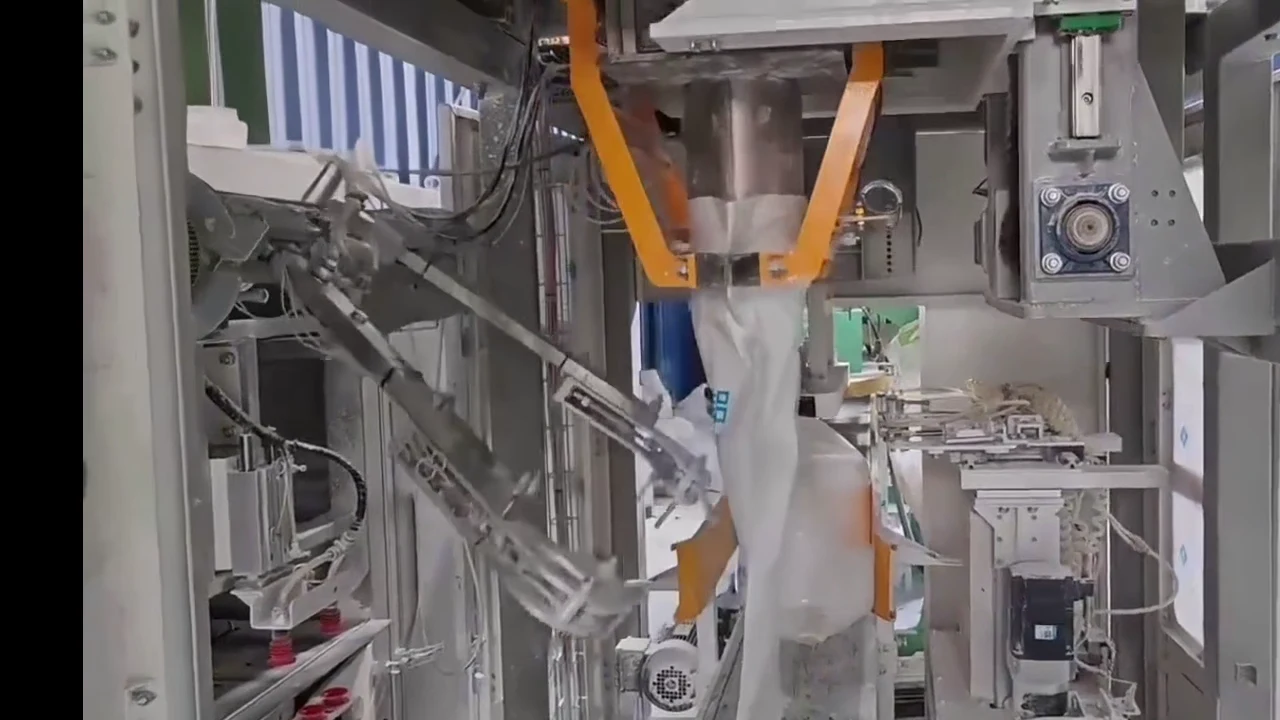
The following are separate customer projects. Together they provide useful questions about interfaces; they do not document one complete automatic line.
- Automatic bagging on site: bag handling and filling, conveyor transfer and the downstream closing area. Wisdom's supply of the bagging, conveying and closing equipment is confirmed; the material is not identified.
- Robotic bag palletizing: the robot picks filled bags from a conveyor and places them on a pallet. Wisdom's supply of the robotic palletizing equipment and conveyor is confirmed.
- Flour bulk-bag filling: flour and customer-site operation are confirmed, with a bulk-bag filling station and transfer conveyor in the approved project record. The published clip focuses on filling; a later still in the case shows filled bags from the same recording.
These records identify supplied equipment and observed operations. They do not publish complete-line output tests or establish bag weights, load ratings, weight accuracy or hygiene and dust-performance guarantees.
Compare the proposed scope and acceptance conditions
Begin the conversation with your material, bag type or photos, target bag weight and target throughput. Add a site sketch when available. During the review:
- Mark supplied, existing, bought-out and excluded equipment on one scope list.
- Confirm bag placement, closing, empty-pallet supply and full-pallet removal responsibilities.
- Review the constrained step and the response to upstream or downstream interruptions.
- Agree the material, bags, pallet pattern and operating sequence for the complete-cycle test.
- Have the final quotation reflect the agreed interfaces, layout and control responsibilities.
Sources
The references below discuss connected packaging operations and line constraints. Equipment and software features in those examples belong to their respective manufacturers.
- RBTX Learn by igus: Packaging Line Bottlenecks (line constraints, transfer and coordination).
- BEUMER: Downtimes? OK, but only if they're pre-planned! (connected packaging operations and controls).
Discuss the whole operating sequence.
Send your material, bag type or photos, target bag weight and target throughput. A simple site sketch can follow as WISDOM reviews the equipment boundaries and the interfaces to confirm.
Talk to WISDOM