


Material and upstream supply
A bulk bag filler must receive and control the material that actually arrives at the station. Describe its physical state, particle condition, moisture and temperature, including changes between batches. A material name alone is too broad to select the feeder.
Flow behavior affects feeding. A free-flowing material and one that bridges, sticks or arrives aerated can behave differently at the same inlet. Gravity, screw or other feeding arrangements should be assessed against that behavior and the upstream source. Powder does not automatically require a screw; granules do not automatically make gravity feeding suitable.
Bulk density affects bag volume. At the same target weight, a lower-density material takes up more space. Loose and settled density can differ, so ask whether the intended weight fits the bag and whether a settling trial is needed. Dustiness also affects the filling connection and air-handling requirements. These are among the material and bag considerations covered in Spiroflow's customization guide.
Describe how material reaches the filler: from an overhead hopper, a conveyor or an intermittent upstream process. Ask the supplier to include this interface in the proposal and explain how filling responds when supply pauses. A demonstration with a continuously supplied hopper may not represent your line.
Bag and liner compatibility
An FIBC (flexible intermediate bulk container) is also called a bulk bag or big bag. It has no universal filled weight. Select the target load against the actual bag specification and confirm the rated limits of the proposed filling and handling equipment.
Send photos or a sample showing the inlet spout or open top, loop number and position, bag dimensions and any liner. The filling head must fit the opening; the supports must suit the loops and bag height. A liner brings another connection and closure to check, including whether it stays open and correctly positioned during filling.
Ask to see how your bag is attached, supported, disconnected and closed. Confirm adjustments for other bag sizes. Spiroflow's C-Series operation sequence separates loop attachment, spout or liner connection, filling and removal, a useful way to review these interfaces.
If your package is an individual open-mouth bag handled through a closing line, use the open-mouth bagging selection guide. Its bag-placement and downstream palletizing discussion covers a different handling scope.
Weighing and filling requirements
Specify the target filled weight, planned weight changes and allowable weight variation. Agree how the result will be checked with your material and bags. A displayed target is not a measured filling result.
Weighing arrangement. Material can be weighed as the bag fills, or a batch can be weighed in an upstream hopper before discharge. Ask what is included in the measured load and how the empty bag and any pallet are accounted for. Flexicon's filling-system overview describes direct bag weighing and pre-weigh options; the suitable arrangement still depends on the project.
Feed control. Ask how material flow starts, changes near the target and stops. Confirm the feeder, controls and upstream interface included in the quotation. Request the test conditions behind any proposed accuracy figure.
Air and dust handling. As product enters, displaced air needs an agreed route out. Review the bag connection, vent path and dust-collection interface, especially with a liner or dusty material. Bag inflation and settling or vibration functions are separate items to assess and confirm, rather than assumed standard features.
For dust, static or hygiene requirements, provide the actual material and project requirements for assessment. Ask for the proposed scope and supporting documentation. A flour application alone does not establish a food-grade or explosion-protection certification.
Bag removal, layout and automation
Start at the end of big bag filling: where does the full bag go next? Agree whether it leaves on a pallet, through a conveyor or by another proposed handling method. Check the filled dimensions, load, transfer height and access needed for the chosen route. The equipment that removes the bag must be specified for that bag and load.
Review the installed layout with the upstream outlet and downstream receiving point. Include ceiling clearance, the filling-head connection, room for bag changes and closing, empty-bag storage, and access for cleaning and maintenance. The machine footprint alone does not describe the space needed to operate it.
Separate filling automation from bag-handling automation. Machine-controlled weighing and filling do not establish automatic loop hanging, spout attachment, liner closure, loop release or filled-bag removal. Ask the supplier to mark each operation as automatic or operator-assisted and state which mechanisms are included.
A robotic palletizer that stacks individual small bags is not evidence of filled-FIBC handling. Review the bulk-bag removal equipment directly. Wisdom's current equipment entry is Bulk bag / FIBC filling; confirm the configuration and interfaces for your project.
Throughput as a complete cycle
Ask for output from one empty bag ready for attachment to the next bag ready for filling, rather than only the time that material flows. Include hanging the loops, connecting the spout or liner, filling, any settling and weight check, disconnecting, closing, removing the full bag and presenting the next bag. Include pallet exchange where applicable.
Some operations may overlap. For example, a separate pre-weigh stage can prepare a batch while bags are exchanged, as illustrated in Flexicon's pneumatic feed and weigh-batching example (PDF). That arrangement is a general engineering example, not a confirmed Wisdom option.
Compare proposals under the same material supply, bag, target weight and handling conditions. Ask what interrupts the cycle and which actions need an operator. A short filling clip cannot establish sustained output; any throughput commitment needs an agreed complete-cycle test.
A real flour bulk-bag filling example
Wisdom's flour bulk-bag filling case connects the selection questions to an actual customer-site application.
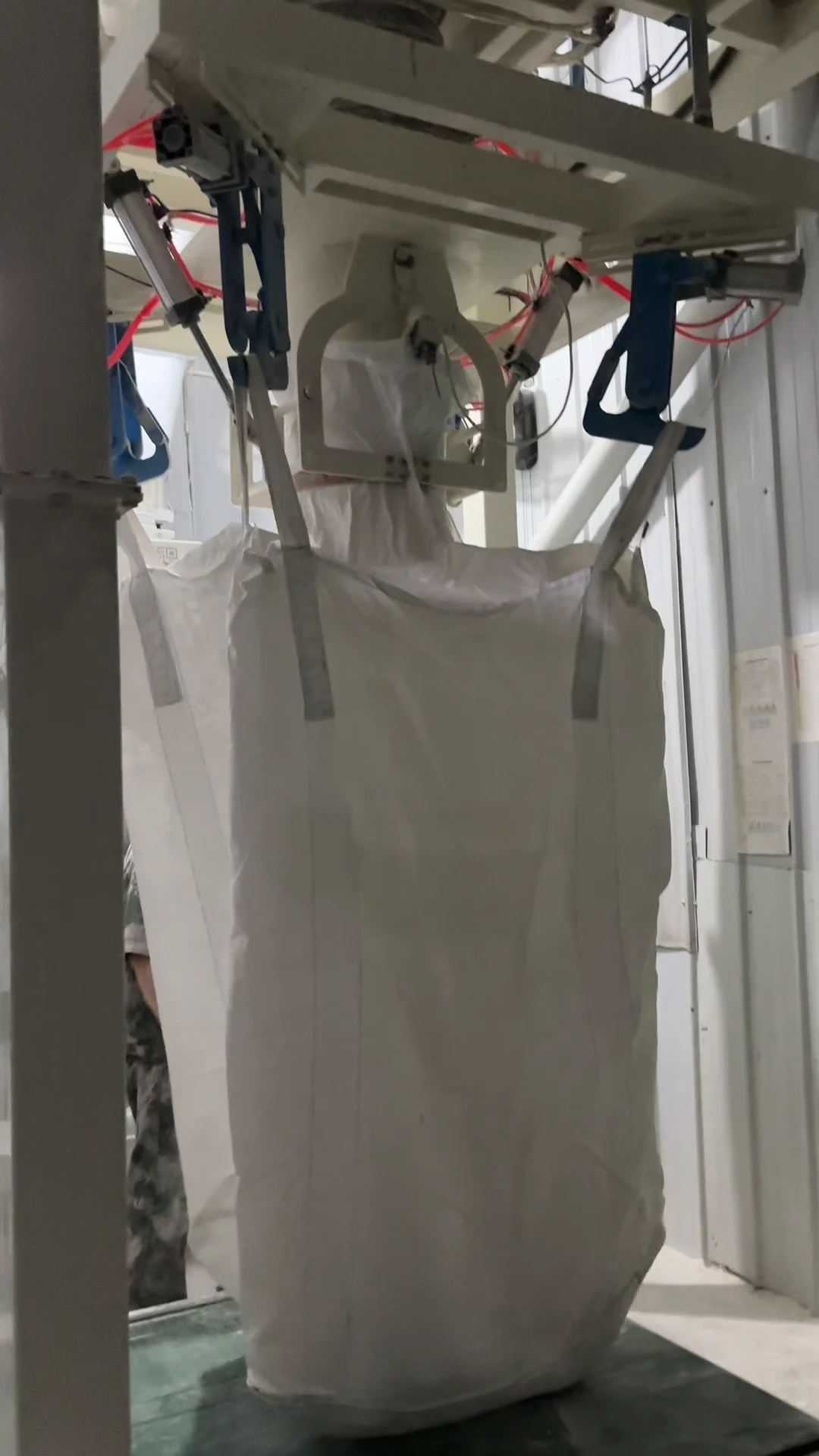
What the video shows. The published excerpt focuses on filling with the bag supported at the station. The case's additional still shows filled bulk bags later in the same source recording.
What is confirmed. The approved project record identifies flour and customer-site operation, with a support and filling station, bag clamping arrangement and filled-bag transfer conveyor. The project owner confirmed Wisdom's supply of the bulk-bag filling equipment and transfer conveyor.
What is not published. Bag weight, measured accuracy, sustained output and equipment load ratings are not public specifications for this case. The footage also does not establish dust-extraction performance, hygiene compliance or certifications. Use it to discuss bag support and the removal route, then confirm your own requirements.
A short buying checklist
For the first contact, send just the material, bag type or photos, target bag weight and required output. The remaining details below can be completed with the supplier as the configuration takes shape.
| You provide | Configuration affected | Confirm next |
|---|---|---|
| Material and upstream source | Feeding and supply interface | Flow, bulk density, dust and any sample trial |
| Bag type or photos | Filling connection and bag supports | Dimensions, loops, inlet, liner and rated load |
| Target bag weight | Weighing and feed control | Weight variation, load limits and test conditions |
| Required output | Cycle sequence and automation scope | Manual tasks, supply pauses and complete-cycle test |
| Removal route and layout | Full-bag transfer and installation | Pallet, transfer heights, headroom and working access |
| Site and product requirements | Utilities, cleaning and containment scope | Power, dust, static or hygiene assessment and documentation |
Sources
These manufacturer references support general selection principles. Their designs, options and performance claims do not describe Wisdom's supplied scope.
- Spiroflow: Bulk Bag Filler Customization Guide (material and bag considerations).
- Spiroflow: C-Series Bulk Bag Fillers (bag connection and operation sequence).
- Flexicon: Bulk Bag Filling Systems (weighing, venting and handling interfaces).
- Flexicon: Bulk Bag Filler with Pneumatic Material Feed System (PDF) (separate batch weighing and bag exchange).
Discuss your bulk-bag configuration.
Send your material, bag type or photos, target bag weight and required output. Wisdom can review these inputs with you and identify what needs further confirmation.
Talk to Wisdom