


Measure the bag after filling and closing
Use the bag condition that reaches the palletizer. An empty bag's nominal dimensions do not describe its filled footprint, bulging or closure. Measure representative filled bags after the handling or settling expected in the line, and record variation rather than a single ideal sample.
Include stiffness, surface condition and deformation under load. Material movement inside a flexible bag can change its shape during pickup and placement. Tell the supplier if the bags retain their shape or spread as layers are added.
Target bag weight remains an input for handling and total load, but it does not determine the footprint. Ask how the proposal accommodates the actual range of bag shapes at the palletizer entry.
Establish the pallet support and finished-load limits
Provide the actual pallet dimensions and specification, including the usable deck and any restrictions on overhang. Confirm that edge bags remain supported in the proposed layer. Also identify any restrictions from storage, doors, vehicles or downstream handling.
Concetti's palletiser brochure (PDF) and Premier Tech's bag-palletizer documentation treat bag dimensions, pallet dimensions and the completed load as separate inputs. Their machine limits and options apply to their own equipment, not to Wisdom's.
Keep layer count, total stack height and total load separate in the review. More bags add weight and may compress or deform the bags below. Confirm the pallet and proposed equipment ratings against the actual load; do not infer them from a pattern drawing or project video.
Draw the layer and its orientation sequence
Start with a layer drawing based on the filled-bag footprint. Show bags per layer, each bag's orientation and where it sits relative to the pallet edges. A simple count hides whether bags fit, touch, leave gaps or require turning before placement.
Then show how successive layers relate. Repeating a layer and changing orientation or interlocking layers are arrangements to evaluate. Interlocking does not automatically make every flexible-bag load more stable, and no bag count is universally best.
Where overlap or an alternating arrangement is proposed, ask how each bag is supported and how the actual bags respond as height increases. Compare candidate patterns on fit, handling and the finished load, rather than choosing the most compact drawing alone.
Check how the pattern will be formed
Bag shape and stability affect how a robot gripper can pick, hold and release a bag. They also affect orientation and layer formation in a high-level palletizing system. Ask what bag condition the proposed handling method needs at its inlet, and whether turning or conditioning equipment is included.
BEUMER's paletpac documentation connects bag handling, orientation and layer formation. Its specific mechanisms and performance are manufacturer features, not evidence of Wisdom options.
Review your bag and pattern with Wisdom's palletizing equipment entry. If you are choosing the palletizing technology itself, see Robotic vs High-Level Palletizing. Here, the decision is how the bags should be arranged on the pallet.
Check the pattern as a finished load
Use this table to turn the drawing into a testable requirement. The final arrangement depends on the bags, pallet and intended movement.
| Planning variable | Why it changes the pattern | What to check with the supplier |
|---|---|---|
| Filled bag dimensions and shape | Flexible bags occupy a different footprint after filling and handling | Representative measurements, variation, bulging and the condition at palletizer entry |
| Pallet dimensions and usable deck | The support area sets the space available for each layer | Actual pallet specification, bag support at edges and any overhang restriction |
| Bags per layer and orientation | The same count can be arranged in different footprints | A layer drawing using filled bags, turning requirements and handling sequence |
| Layer sequence and total height | Upper layers load and may deform the bags below | Layer count, settled height, total load and the limits of the pallet and handling equipment |
| Finished-pallet transport | A stack that stands still must also survive its intended movement | Removal, storage and transport conditions; the load-securing scope and validation method |
Include the finished-pallet route in the trial: removal from the station, storage and the intended onward transport. Agree any wrapping, restraint or other load-securing requirement as a separate scope item. A stable-looking stack at rest is not a transport test.
See real bag handling at a customer site
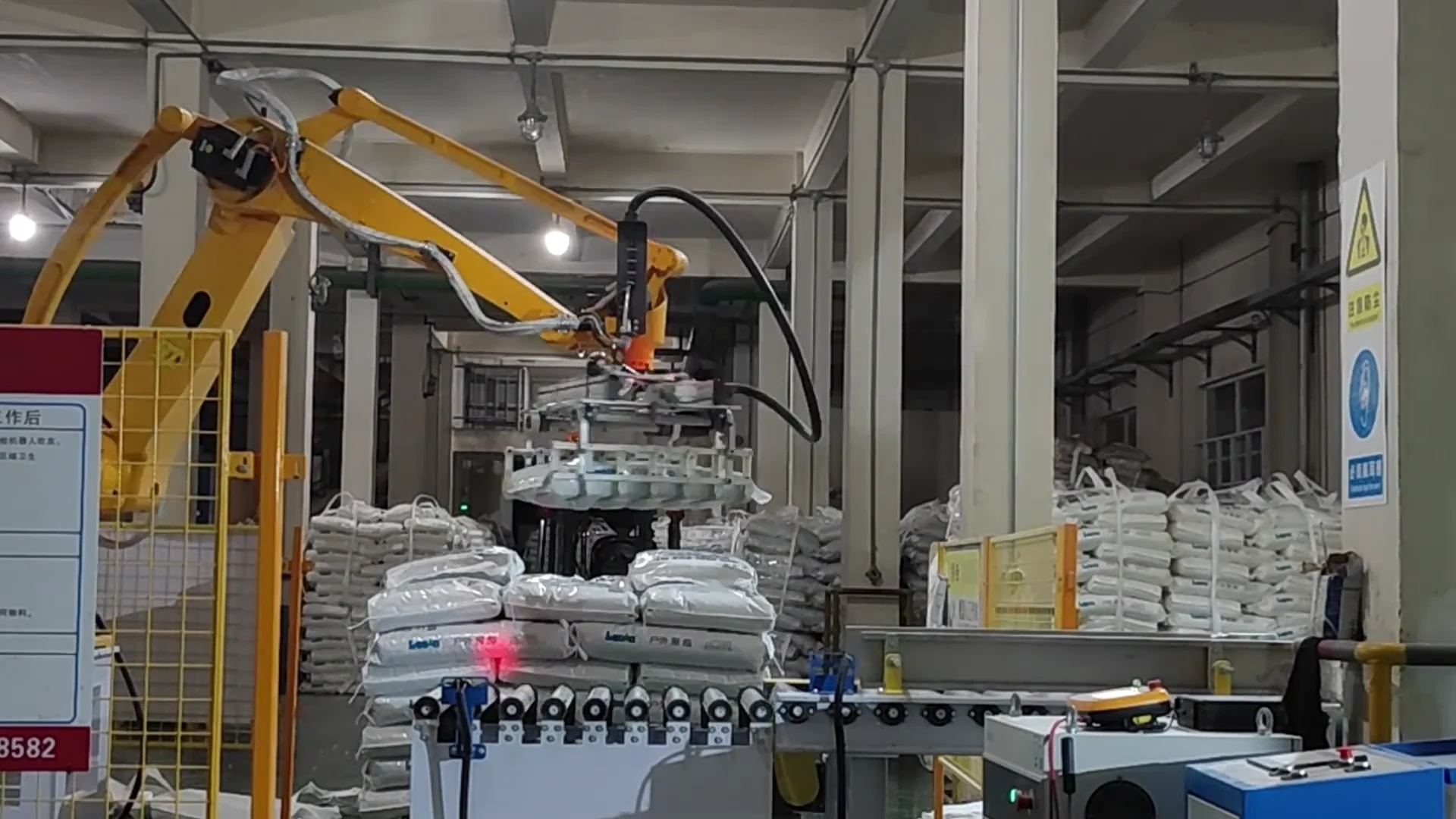
In Wisdom's robotic bag palletizing case, the published sequence shows the robot picking filled bags from a conveyor, transferring them and placing them on a pallet. The approved record confirms customer-site operation and Wisdom's supply of the robotic palletizing equipment and conveyor.
Use the clip to discuss bag presentation and placement. It does not publish a pallet-pattern validation, sustained output, gripper payload, bag weight or transport-stability result. Your bag and finished-load requirements need their own review.
Prepare the pattern review and trial
You can begin with the material, bag photos or sample information, target bag weight and required throughput. Add your pallet specification if it is already available. Complete the following with the supplier:
- Measure representative filled and closed bags, including shape variation after upstream handling.
- Share the pallet specification and finished-load restrictions from storage and transport.
- Request drawings showing orientation, bags per layer and the complete layer sequence.
- Agree layer count, settled height, total load and the handling equipment limits to verify.
- Observe pickup, placement and a representative finished stack; agree how the intended removal and transport will be assessed.
Record the bag condition and pattern used in the trial so the final proposal can be checked against the same requirements.
Sources
These technical documents frame the bag, pallet and handling variables to review. Their model limits, grippers and layer-forming features do not establish Wisdom's supplied scope.
- BEUMER: paletpac Palletisers (bag handling, orientation and layer formation).
- Concetti: Palletisers brochure (PDF) (bag, pallet and finished-load variables).
- Premier Tech CHRONOS: APH-1210 (separate bag, pallet and load dimensions).
Review your bags and pallet together.
Share your material, bag photos or sample information, target bag weight and required throughput. WISDOM can help identify the pallet and filled-bag details needed for a pattern review.
Talk to WISDOM